Real Money Slot Apps for Android No Deposit: The Ugly Truth Behind the Glitter

Real Money Slot Apps for Android No Deposit: The Ugly Truth Behind the Glitter
Most “real money slot apps for android no deposit” promises sound like a magician’s patter, but the maths stays stubbornly arithmetic. Take the 0.97% house edge in a typical 5‑reel slot; it means for every £100 you wager, the casino expects to keep £97. That’s not a gift, it’s a tax.
Betfair’s Android app claims a “free spin” on Starburst, yet the spin lands on a 2‑payline, a quarter of the usual 10‑payline version. In practice you’re trading a potential £5 win for a modest £0.20. It’s a clever bait, but the bait is practically a worm.
And then there’s Ladbrokes, which offers a no‑deposit bonus of 10 “free” credits. Convert those credits at a 0.1 p per credit rate, and you get a maximum of £1.00 to gamble. That’s less than the cost of a cup of tea in a decent cafe.
Because the only thing faster than a slot’s spin is your bank account draining. Gonzo’s Quest, for example, cycles through 20% of its volatility arc in under ten seconds; you’ll see the roller‑coaster of wins and losses faster than a commuter train during rush hour.
Deposit 2 Play with 10 Casino UK: The Brutal Math Behind That “Gift”
Consider the following breakdown:
- Deposit‑free bonus: 10 credits × £0.10 = £1.00
- Average spin cost: £0.05
- Maximum possible spins: 20
- Expected return (RTP 96%): £0.96
That calculation shows you lose £0.04 on average, even before the casino’s terms clip your winnings at £2.00. William Hill’s app mirrors this pattern, swapping “VIP treatment” for a lobby that feels more like a cheap motel with fresh paint – you’re still paying rent.
But the real horror isn’t the percentages; it’s the UI traps. A 7‑pixel tiny font hides the “max bet” button in the corner, forcing players to guess whether they’re betting £0.10 or £1.00. Mis‑clicks become the norm, and the bankroll shrinks accordingly.
Contrast that with the flashy animation of Starburst’s expanding wilds – each burst looks like fireworks, yet each explosion is calibrated to a 2‑to‑1 payout, keeping the overall volatility low. The contrast is deliberate: visual excitement masks the underlying linearity of the paytable.
When a promotion states “no deposit required”, remember the hidden deposit is your time. A typical 15‑minute session yields roughly 150 spins. At an average bet of £0.20, you risk £30, yet the expected return sits at £28.80. That £1.20 loss per session seems trivial until you multiply it by 30 sessions a month – you’re down £36, which is hardly the “free” you were promised.
Free 10 No Deposit Slot Bonus: The Casino’s Latest Cash‑Grab Scam
And because most Android slot apps are built on the same engine, the lag spikes are identical. A 0.2 second delay between spin and outcome forces you to stare at the same three‑line reel, increasing the chance of a mis‑tap. That delay is the casino’s silent partner, nudging you toward an accidental over‑bet.
Ladbrokes’ “free” spin on Gonzo’s Quest comes with a wagering requirement of 30×. That means you must wager £30 to unlock a £1 win. Mathematically, you need a 33.3% win rate just to break even, a figure no slot can sustain.
Even the most popular slot, Starburst, which many claim offers a “quick win”, actually has a volatility rating of 2 out of 5 – meaning wins are frequent but tiny. In contrast, a high‑volatility title like Dead or Alive 2 can double your stake in a single spin, but the odds of hitting that are roughly 1 in 85, far less forgiving than the supposed “no deposit” allure.
Because you can’t ignore the fine print, examine the clause that caps cash‑out at £5.00 for any no‑deposit bonus. If you manage to string together a £4.50 win, the casino will automatically convert the remaining £0.50 into a non‑withdrawable “bonus credit”. It’s mathematically sound, emotionally cruel.
And the most irritating part? The app’s settings page uses a colour palette that makes the “Enable notifications” toggle blend into the background, leading many to miss critical alerts about expiring bonuses. You think you’re safe, but you’re actually sitting on an unused £2.00 bonus that vanishes after 48 hours.
Finally, the absurdity of the tiny font size used for the terms and conditions – a 9‑point Arial on a high‑resolution screen – makes reading the wagering requirements a migraine‑inducing endeavour. It’s the sort of detail that makes you wish slot developers would focus more on clarity than on glittery graphics.

Health & Fitness
The Mock Audit That Pays for Itself: How Internal RADV Simulations Reduce Real Audit Exposure


The Cheapest Audit Defense You Can Build
Internal RADV simulations cost a fraction of actual audit response. A plan selects 100 to 200 enrollee-years from its submitted data, oversampling high-risk diagnosis categories. An internal review team evaluates each sampled HCC against MEAT criteria using the same standard CMS auditors apply. The team calculates an internal error rate, identifies which diagnosis categories fail most often, and documents the specific documentation failures driving those results.
The simulation produces three things no other compliance activity delivers. First, a predictive error rate that forecasts what CMS will find when the real audit arrives. Second, a prioritized remediation list identifying the specific documentation gaps that contribute most to audit failure. Third, a rehearsal of the audit response process that reveals operational bottlenecks before they matter under real deadline pressure.
How to Design a Simulation That Predicts Real Results
The simulation’s predictive value depends on how closely it replicates CMS’s methodology. Sample from your submitted data, not from your coding queue. Include members whose codes were submitted in prior years that haven’t been re-validated. Oversample the high-impact diagnosis categories CMS is known to target: acute stroke, MI, cancer, and other conditions OIG audits have focused on.
Apply the MEAT standard strictly. If the documentation doesn’t show active monitoring, evaluation, assessment, or treatment of the condition during the relevant encounter, the code fails. Don’t give credit for “the provider probably managed this condition.” CMS auditors don’t infer management that isn’t documented. Your simulation shouldn’t either.
Use reviewers who weren’t involved in the original coding decision. If the coder who submitted the code also evaluates it in the simulation, confirmation bias inflates the pass rate. Independent reviewers produce error rates closer to what CMS auditors will find because they evaluate documentation without the context the original coder had.
What the Results Tell You
An internal error rate below 15% suggests your coding program produces predominantly defensible output. Focus remediation on the specific categories and documentation patterns that make up the failing 15%.
An error rate between 15% and 40% signals systematic documentation gaps that need programmatic fixes: enhanced MEAT validation in the coding workflow, category-specific evidence thresholds for high-risk diagnoses, and provider education targeting the documentation patterns that fail most frequently.
An error rate above 40% indicates the program is producing output that won’t survive RADV scrutiny at current quality levels. This requires structural intervention: technology changes, methodology redesign, and immediate proactive deletion of the weakest codes from the plan’s active submissions.
The Investment That Pays Before the Audit Arrives
A quarterly internal simulation costs less than a single week of real RADV response. It predicts audit outcomes before they happen, identifies remediation targets while there’s still time to fix them, and stress-tests the response process under controlled conditions. Plans running regular radv audits simulations convert a reactive, high-stress compliance function into a proactive, predictable one. The simulation doesn’t prevent the audit. It prevents the surprise.
How Prepaid Cards Work at Online Casinos
Prepaid cards have emerged as one of the most discreet and budget-conscious payment methods available to British players. Unlike traditional debit cards linked directly to your bank account, prepaid options , such as Paysafecard or funded Mastercard vouchers , are loaded with a fixed amount of money upfront. This structure appeals strongly to players who want firm control over their gambling spend, as you physically cannot deposit more than the value loaded onto the card. For more details, visit learn more.
The process is straightforward. You purchase a prepaid voucher from a high-street retailer like WHSmith, Tesco, or a Post Office, or you buy one online, and then enter the unique PIN code at the casino cashier. Deposits are processed instantly, meaning you can start playing within seconds. Withdrawals, however, can be trickier, as most prepaid systems are one-way. Casinos will typically ask for an alternative method, like a bank transfer, to cash out winnings.
Security is a major draw. Because prepaid cards are not connected to your personal banking details, they offer a robust layer of protection against fraud and data breaches. For players who prefer not to share sensitive financial information with gaming sites, this anonymity is invaluable. It also prevents accidental overspending, since the card simply declines once the balance hits zero.
One important consideration for UK residents is compliance with regulations set by the Gambling Commission. While prepaid cards are widely accepted, players must still verify their identity when registering at a licensed casino, regardless of the payment method used. This ensures responsible gambling measures remain firmly in place.
Finding the Best Prepaid Card Casinos in Britain
Not every online casino accommodates prepaid payments equally well. The best sites in Britain seamlessly integrate voucher systems into their banking pages and clearly outline any minimum deposit requirements. Typically, you will find minimum deposit thresholds around £10, though some premium platforms cater to higher rollers with larger minimums. It is always wise to check the terms before committing.
Beyond the mechanics of payment, top-tier casinos reward players for choosing their platform. New customers signing up can often claim generous welcome packages designed to extend their playtime immediately. For instance, Free Spins No Deposit UK offers a curated list of promotions where players can access 200 free spins or even a 100 free welcome bonus no deposit required just for registering. These incentives, paired with the safety of prepaid cards, create a low-risk entry point for newcomers.
Game variety is another factor. Leading British casinos hosting prepaid options usually feature extensive libraries of slots and table games. You might encounter offers such as 150 free spins on Book of Dead, no deposit, or specific slot promotions like 20 free spins on Big Bass Bonanza, no deposit. These targeted bonuses allow you to test popular titles without dipping into your own funds.
Customer support also separates the elite from the average. Reputable UK casinos provide 24/7 live chat and comprehensive FAQs to resolve any deposit issues quickly. When using prepaid vouchers, having reliable assistance ensures that a mistyped PIN or transaction hiccup does not derail your gaming session.
Maximising Value and Practising Responsible Play
To get the most from prepaid card casinos, take advantage of no-wagering offers whenever possible. Promotions like 50 free spins no deposit no wager allow you to keep every penny you win without meeting complicated playthrough requirements. Similarly, deals offering £10 free no deposit give you a tangible bankroll boost simply for signing up.
Always set a strict budget before purchasing your prepaid card. Treat the loaded amount as entertainment money, not an investment. The fixed nature of the card is your greatest ally here; once it is gone, the session ends. This built-in limit is far more effective than relying on willpower alone.
Finally, verify that the casino holds a valid licence from the UK Gambling Commission. Licensed operators must adhere to strict fairness standards and offer tools like deposit limits and self-exclusion. By combining these safeguards with the disciplined nature of prepaid cards, British players can enjoy online gaming on their own terms, safely and responsibly.
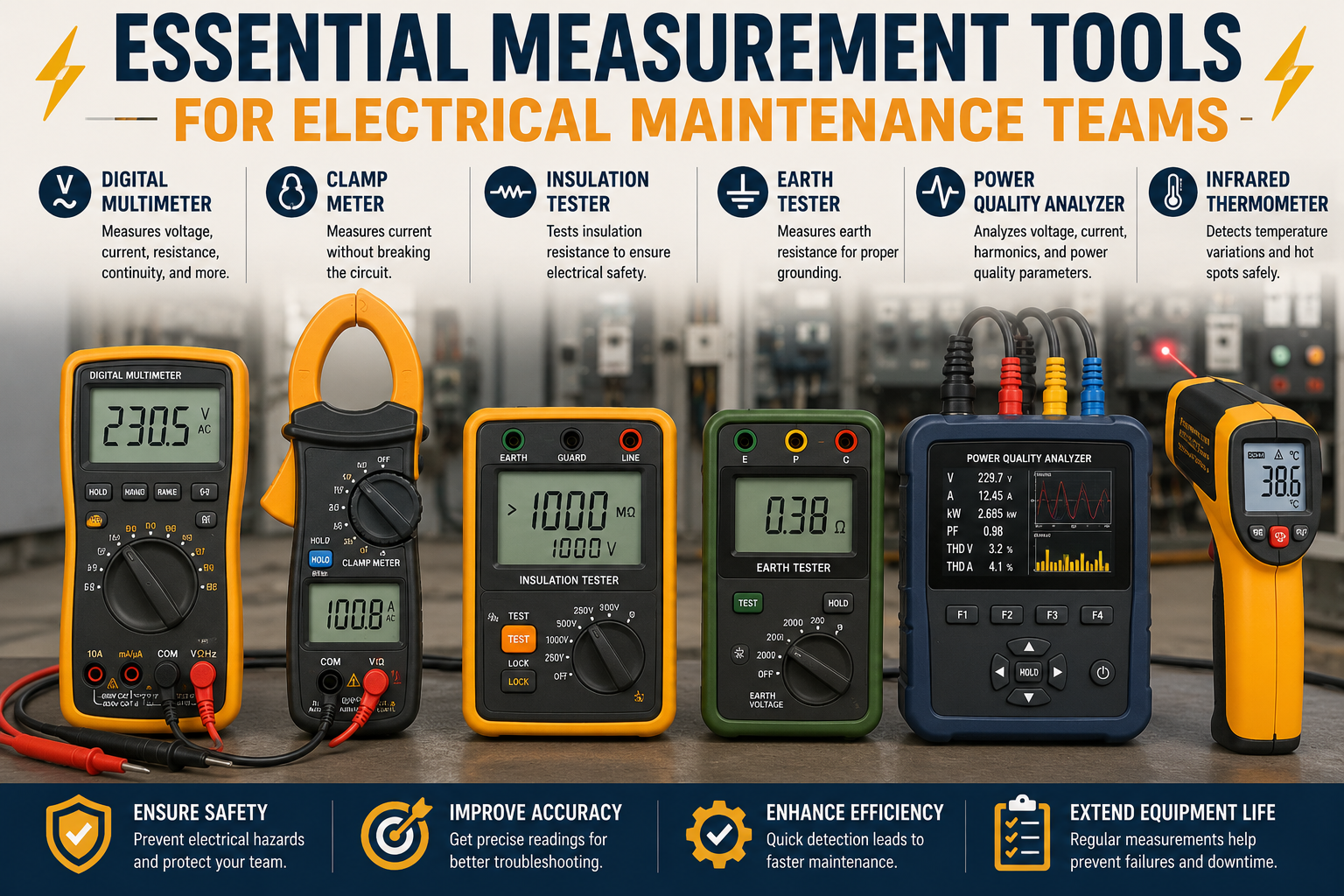
The job of an electrical maintenance team goes far beyond merely reacting to faults. That’s because, whether such personnel are operating across commercial premises, industrial installations, or facilities management environments, they also need to be proficient in overseeing accurate diagnostics, preventative testing, and documentation for compliance. These are all vital elements of maintenance.
To accomplish all this, however, these team members will need access to suitable electrical measurement tools. This will leave them strongly placed to identify issues earlier, minimise downtime, and improve electrical safety.
Here, then, are some of the measurement instruments they should have to hand.
- Digital Multimeters (DMMs): The Everyday Essential
If there is a single measurement tool that can claim to be the backbone of any electrical toolkit, it has to be a digital multimeter.
Often the first tool a maintenance staffer takes out of their case, a DMM supports routine fault-finding and verification by measuring:
- AC/DC voltage
- AC/DC current
- Resistance
- Continuity
- Diode function
- In some models, capacitance and frequency
The reputation of digital multimeters as hugely versatile testing tools can be attributed to their combination of multiple measurement functions into one handheld device. They’re a “go-to” for the quick diagnosis of circuits, outlets, motors, and control panels.
For maintenance staff whose work will bring them into contact with variable speed drives, modern building systems, and non-linear loads, it is advisable to seek out a DMM with true-RMS (Root Mean Square) capability.
- Clamp Meters: Safe Current Measurement
Also often referred to as “current clamps”, clamp meters give electricians and maintenance engineers a way of measuring current without the need to disconnect conductors. This can be ideal for live systems where breaking the circuit wouldn’t be a practical course of action.
So, whenever maintenance professionals find themselves needing to measure load current on cables, check for imbalances in three-phase systems, or troubleshoot motors or HVAC installations, a clamp meter can be an indispensable tool to have.
- Insulation Resistance Testers: Prevent Problems Before Failure
The degradation of insulation is a common cause of electrical faults. So, it greatly helps maintenance personnel if they have an instrument to hand that can detect such deterioration in cables, motors, transformers, and switchgear.
This is exactly what an insulation resistance tester, also often called a “megohmmeter” or even just an “insulation tester”, enables them to do.
A megohmmeter helps the evaluation of insulation condition by applying a controlled test voltage. This allows maintenance teams to identify deterioration early and reduce the risk of faults or hazards.
- Earth And Installation Testers: Supporting Compliance and Safety
It is critical for electrical installations to perform safely under fault conditions.
Installation testers can greatly help here, by enabling maintenance teams to verify such aspects as earth continuity, loop impedance, residual current device (RCD) performance, earth resistance, and installation integrity.
An installation tester is a comprehensive, multifunction diagnostic device for verifying the safety and integrity of fixed electrical wiring.
Meanwhile, an earth tester serves the purpose of measuring the electrical resistance between an installation’s earthing system and the soil.
- Oscilloscopes: Seeing Problems That Meters Miss
As useful as a standard multimeter can be, a key limitation is that it only provides numerical measurements. As a result, it may not reveal transient behaviour or waveform shape. An oscilloscope, on the other hand, helps reveal electrical noise, spikes, signal distortion, and transient events.
By showing how electrical signals change over time, an oscilloscope can help draw attention to issues that might otherwise stay hidden to maintenance engineers.
Just A Few More Things for Maintenance Teams to Bear in Mind…
…it might seem overly “obvious” advice, but it is worth emphasising the importance of investing in quality tools from reputable suppliers. This helps ensure the equipment can rapidly pay for itself through reduced downtime and fewer emergency callouts.
Remember, too, that the instruments featured in this rundown must always be paired with proper training, appropriate personal protective equipment (PPE), and adherence to relevant regulations and standards. An example of the latter is the IET Wiring Regulations (BS 7671) for maintenance teams operating in the UK.
The Mock Audit That Pays for Itself: How Internal RADV Simulations Reduce Real Audit Exposure
Prepaid Card Casinos: A Safe and Simple Way to Play in Britain

Essential Measurement Tools for Electrical Maintenance Teams

Ben Shephard Wife Illness: What Is Really Known About Annie’s Health And Their Life Together

Mark Redknapp: The Real Story Behind Harry Redknapp’s Low-Key Son

Salish Matter – From YouTube Star to Global Teen Icon
Real Money Slot Apps for Android No Deposit: The Ugly Truth Behind the Glitter
Real Money Slot Apps for Android No Deposit: The Ugly Truth Behind the Glitter
Most “real money slot apps for android no deposit” promises sound like a magician’s patter, but the maths stays stubbornly arithmetic. Take the 0.97% house edge in a typical 5‑reel slot; it means for every £100 you wager, the casino expects to keep £97. That’s not a gift, it’s a tax.
2 Free Casino Bonus UK: The Cold Hard Truth Behind the Glitter
Betfair’s Android app claims a “free spin” on Starburst, yet the spin lands on a 2‑payline, a quarter of the usual 10‑payline version. In practice you’re trading a potential £5 win for a modest £0.20. It’s a clever bait, but the bait is practically a worm.
And then there’s Ladbrokes, which offers a no‑deposit bonus of 10 “free” credits. Convert those credits at a 0.1 p per credit rate, and you get a maximum of £1.00 to gamble. That’s less than the cost of a cup of tea in a decent cafe.
Because the only thing faster than a slot’s spin is your bank account draining. Gonzo’s Quest, for example, cycles through 20% of its volatility arc in under ten seconds; you’ll see the roller‑coaster of wins and losses faster than a commuter train during rush hour.
Consider the following breakdown:
- Deposit‑free bonus: 10 credits × £0.10 = £1.00
- Average spin cost: £0.05
- Maximum possible spins: 20
- Expected return (RTP 96%): £0.96
That calculation shows you lose £0.04 on average, even before the casino’s terms clip your winnings at £2.00. William Hill’s app mirrors this pattern, swapping “VIP treatment” for a lobby that feels more like a cheap motel with fresh paint – you’re still paying rent.
But the real horror isn’t the percentages; it’s the UI traps. A 7‑pixel tiny font hides the “max bet” button in the corner, forcing players to guess whether they’re betting £0.10 or £1.00. Mis‑clicks become the norm, and the bankroll shrinks accordingly.
Contrast that with the flashy animation of Starburst’s expanding wilds – each burst looks like fireworks, yet each explosion is calibrated to a 2‑to‑1 payout, keeping the overall volatility low. The contrast is deliberate: visual excitement masks the underlying linearity of the paytable.
Real Money Casino Free Spins No Deposit: The Cold‑Hard Gamble No One Talks About
When a promotion states “no deposit required”, remember the hidden deposit is your time. A typical 15‑minute session yields roughly 150 spins. At an average bet of £0.20, you risk £30, yet the expected return sits at £28.80. That £1.20 loss per session seems trivial until you multiply it by 30 sessions a month – you’re down £36, which is hardly the “free” you were promised.
Online Slots Win Real Cash UK: The Grind Behind the Glitter
And because most Android slot apps are built on the same engine, the lag spikes are identical. A 0.2 second delay between spin and outcome forces you to stare at the same three‑line reel, increasing the chance of a mis‑tap. That delay is the casino’s silent partner, nudging you toward an accidental over‑bet.
Blackjack Hands Chart: The Brutal Truth Behind the Numbers
Ladbrokes’ “free” spin on Gonzo’s Quest comes with a wagering requirement of 30×. That means you must wager £30 to unlock a £1 win. Mathematically, you need a 33.3% win rate just to break even, a figure no slot can sustain.
Best Debit Card Casino No Verification Casino UK: The Brutal Truth Behind the “Free” Glitter
Even the most popular slot, Starburst, which many claim offers a “quick win”, actually has a volatility rating of 2 out of 5 – meaning wins are frequent but tiny. In contrast, a high‑volatility title like Dead or Alive 2 can double your stake in a single spin, but the odds of hitting that are roughly 1 in 85, far less forgiving than the supposed “no deposit” allure.
Because you can’t ignore the fine print, examine the clause that caps cash‑out at £5.00 for any no‑deposit bonus. If you manage to string together a £4.50 win, the casino will automatically convert the remaining £0.50 into a non‑withdrawable “bonus credit”. It’s mathematically sound, emotionally cruel.
And the most irritating part? The app’s settings page uses a colour palette that makes the “Enable notifications” toggle blend into the background, leading many to miss critical alerts about expiring bonuses. You think you’re safe, but you’re actually sitting on an unused £2.00 bonus that vanishes after 48 hours.
Finally, the absurdity of the tiny font size used for the terms and conditions – a 9‑point Arial on a high‑resolution screen – makes reading the wagering requirements a migraine‑inducing endeavour. It’s the sort of detail that makes you wish slot developers would focus more on clarity than on glittery graphics.
Health & Fitness
The Mock Audit That Pays for Itself: How Internal RADV Simulations Reduce Real Audit Exposure
The Cheapest Audit Defense You Can Build
Internal RADV simulations cost a fraction of actual audit response. A plan selects 100 to 200 enrollee-years from its submitted data, oversampling high-risk diagnosis categories. An internal review team evaluates each sampled HCC against MEAT criteria using the same standard CMS auditors apply. The team calculates an internal error rate, identifies which diagnosis categories fail most often, and documents the specific documentation failures driving those results.
The simulation produces three things no other compliance activity delivers. First, a predictive error rate that forecasts what CMS will find when the real audit arrives. Second, a prioritized remediation list identifying the specific documentation gaps that contribute most to audit failure. Third, a rehearsal of the audit response process that reveals operational bottlenecks before they matter under real deadline pressure.
How to Design a Simulation That Predicts Real Results
The simulation’s predictive value depends on how closely it replicates CMS’s methodology. Sample from your submitted data, not from your coding queue. Include members whose codes were submitted in prior years that haven’t been re-validated. Oversample the high-impact diagnosis categories CMS is known to target: acute stroke, MI, cancer, and other conditions OIG audits have focused on.
Apply the MEAT standard strictly. If the documentation doesn’t show active monitoring, evaluation, assessment, or treatment of the condition during the relevant encounter, the code fails. Don’t give credit for “the provider probably managed this condition.” CMS auditors don’t infer management that isn’t documented. Your simulation shouldn’t either.
Use reviewers who weren’t involved in the original coding decision. If the coder who submitted the code also evaluates it in the simulation, confirmation bias inflates the pass rate. Independent reviewers produce error rates closer to what CMS auditors will find because they evaluate documentation without the context the original coder had.
What the Results Tell You
An internal error rate below 15% suggests your coding program produces predominantly defensible output. Focus remediation on the specific categories and documentation patterns that make up the failing 15%.
An error rate between 15% and 40% signals systematic documentation gaps that need programmatic fixes: enhanced MEAT validation in the coding workflow, category-specific evidence thresholds for high-risk diagnoses, and provider education targeting the documentation patterns that fail most frequently.
An error rate above 40% indicates the program is producing output that won’t survive RADV scrutiny at current quality levels. This requires structural intervention: technology changes, methodology redesign, and immediate proactive deletion of the weakest codes from the plan’s active submissions.
The Investment That Pays Before the Audit Arrives
A quarterly internal simulation costs less than a single week of real RADV response. It predicts audit outcomes before they happen, identifies remediation targets while there’s still time to fix them, and stress-tests the response process under controlled conditions. Plans running regular radv audits simulations convert a reactive, high-stress compliance function into a proactive, predictable one. The simulation doesn’t prevent the audit. It prevents the surprise.
How Prepaid Cards Work at Online Casinos
Prepaid cards have emerged as one of the most discreet and budget-conscious payment methods available to British players. Unlike traditional debit cards linked directly to your bank account, prepaid options , such as Paysafecard or funded Mastercard vouchers , are loaded with a fixed amount of money upfront. This structure appeals strongly to players who want firm control over their gambling spend, as you physically cannot deposit more than the value loaded onto the card. For more details, visit learn more.
The process is straightforward. You purchase a prepaid voucher from a high-street retailer like WHSmith, Tesco, or a Post Office, or you buy one online, and then enter the unique PIN code at the casino cashier. Deposits are processed instantly, meaning you can start playing within seconds. Withdrawals, however, can be trickier, as most prepaid systems are one-way. Casinos will typically ask for an alternative method, like a bank transfer, to cash out winnings.
Security is a major draw. Because prepaid cards are not connected to your personal banking details, they offer a robust layer of protection against fraud and data breaches. For players who prefer not to share sensitive financial information with gaming sites, this anonymity is invaluable. It also prevents accidental overspending, since the card simply declines once the balance hits zero.
One important consideration for UK residents is compliance with regulations set by the Gambling Commission. While prepaid cards are widely accepted, players must still verify their identity when registering at a licensed casino, regardless of the payment method used. This ensures responsible gambling measures remain firmly in place.
Finding the Best Prepaid Card Casinos in Britain
Not every online casino accommodates prepaid payments equally well. The best sites in Britain seamlessly integrate voucher systems into their banking pages and clearly outline any minimum deposit requirements. Typically, you will find minimum deposit thresholds around £10, though some premium platforms cater to higher rollers with larger minimums. It is always wise to check the terms before committing.
Beyond the mechanics of payment, top-tier casinos reward players for choosing their platform. New customers signing up can often claim generous welcome packages designed to extend their playtime immediately. For instance, Free Spins No Deposit UK offers a curated list of promotions where players can access 200 free spins or even a 100 free welcome bonus no deposit required just for registering. These incentives, paired with the safety of prepaid cards, create a low-risk entry point for newcomers.
Game variety is another factor. Leading British casinos hosting prepaid options usually feature extensive libraries of slots and table games. You might encounter offers such as 150 free spins on Book of Dead, no deposit, or specific slot promotions like 20 free spins on Big Bass Bonanza, no deposit. These targeted bonuses allow you to test popular titles without dipping into your own funds.
Customer support also separates the elite from the average. Reputable UK casinos provide 24/7 live chat and comprehensive FAQs to resolve any deposit issues quickly. When using prepaid vouchers, having reliable assistance ensures that a mistyped PIN or transaction hiccup does not derail your gaming session.
Maximising Value and Practising Responsible Play
To get the most from prepaid card casinos, take advantage of no-wagering offers whenever possible. Promotions like 50 free spins no deposit no wager allow you to keep every penny you win without meeting complicated playthrough requirements. Similarly, deals offering £10 free no deposit give you a tangible bankroll boost simply for signing up.
Always set a strict budget before purchasing your prepaid card. Treat the loaded amount as entertainment money, not an investment. The fixed nature of the card is your greatest ally here; once it is gone, the session ends. This built-in limit is far more effective than relying on willpower alone.
Finally, verify that the casino holds a valid licence from the UK Gambling Commission. Licensed operators must adhere to strict fairness standards and offer tools like deposit limits and self-exclusion. By combining these safeguards with the disciplined nature of prepaid cards, British players can enjoy online gaming on their own terms, safely and responsibly.
The job of an electrical maintenance team goes far beyond merely reacting to faults. That’s because, whether such personnel are operating across commercial premises, industrial installations, or facilities management environments, they also need to be proficient in overseeing accurate diagnostics, preventative testing, and documentation for compliance. These are all vital elements of maintenance.
To accomplish all this, however, these team members will need access to suitable electrical measurement tools. This will leave them strongly placed to identify issues earlier, minimise downtime, and improve electrical safety.
Here, then, are some of the measurement instruments they should have to hand.
- Digital Multimeters (DMMs): The Everyday Essential
If there is a single measurement tool that can claim to be the backbone of any electrical toolkit, it has to be a digital multimeter.
Often the first tool a maintenance staffer takes out of their case, a DMM supports routine fault-finding and verification by measuring:
- AC/DC voltage
- AC/DC current
- Resistance
- Continuity
- Diode function
- In some models, capacitance and frequency
The reputation of digital multimeters as hugely versatile testing tools can be attributed to their combination of multiple measurement functions into one handheld device. They’re a “go-to” for the quick diagnosis of circuits, outlets, motors, and control panels.
For maintenance staff whose work will bring them into contact with variable speed drives, modern building systems, and non-linear loads, it is advisable to seek out a DMM with true-RMS (Root Mean Square) capability.
- Clamp Meters: Safe Current Measurement
Also often referred to as “current clamps”, clamp meters give electricians and maintenance engineers a way of measuring current without the need to disconnect conductors. This can be ideal for live systems where breaking the circuit wouldn’t be a practical course of action.
So, whenever maintenance professionals find themselves needing to measure load current on cables, check for imbalances in three-phase systems, or troubleshoot motors or HVAC installations, a clamp meter can be an indispensable tool to have.
- Insulation Resistance Testers: Prevent Problems Before Failure
The degradation of insulation is a common cause of electrical faults. So, it greatly helps maintenance personnel if they have an instrument to hand that can detect such deterioration in cables, motors, transformers, and switchgear.
This is exactly what an insulation resistance tester, also often called a “megohmmeter” or even just an “insulation tester”, enables them to do.
A megohmmeter helps the evaluation of insulation condition by applying a controlled test voltage. This allows maintenance teams to identify deterioration early and reduce the risk of faults or hazards.
- Earth And Installation Testers: Supporting Compliance and Safety
It is critical for electrical installations to perform safely under fault conditions.
Installation testers can greatly help here, by enabling maintenance teams to verify such aspects as earth continuity, loop impedance, residual current device (RCD) performance, earth resistance, and installation integrity.
An installation tester is a comprehensive, multifunction diagnostic device for verifying the safety and integrity of fixed electrical wiring.
Meanwhile, an earth tester serves the purpose of measuring the electrical resistance between an installation’s earthing system and the soil.
- Oscilloscopes: Seeing Problems That Meters Miss
As useful as a standard multimeter can be, a key limitation is that it only provides numerical measurements. As a result, it may not reveal transient behaviour or waveform shape. An oscilloscope, on the other hand, helps reveal electrical noise, spikes, signal distortion, and transient events.
By showing how electrical signals change over time, an oscilloscope can help draw attention to issues that might otherwise stay hidden to maintenance engineers.
Just A Few More Things for Maintenance Teams to Bear in Mind…
…it might seem overly “obvious” advice, but it is worth emphasising the importance of investing in quality tools from reputable suppliers. This helps ensure the equipment can rapidly pay for itself through reduced downtime and fewer emergency callouts.
Remember, too, that the instruments featured in this rundown must always be paired with proper training, appropriate personal protective equipment (PPE), and adherence to relevant regulations and standards. An example of the latter is the IET Wiring Regulations (BS 7671) for maintenance teams operating in the UK.